We are always interested in meeting motivated candidates eager to explore potential opportunities within our team. The group is based at the METU Informatics Institute in Ankara, Türkiye, and we work on the computational systems biology of ageing, at the intersection of ageing, the microbiome, and computational biology.
Open positions
Our group has been awarded a three-year TÜBİTAK 2232-A fellowship at METU, on the biology of ageing. The contract is being finalised, and we are opening recruitment now so that we can start as soon as it is in place. Within this project we aim to recruit up to four PhD students and one postdoctoral researcher. The expected start date is March 2027; the positions are three years long, in the Department of Health Informatics, METU Informatics Institute, and funded at the programme’s published rates.
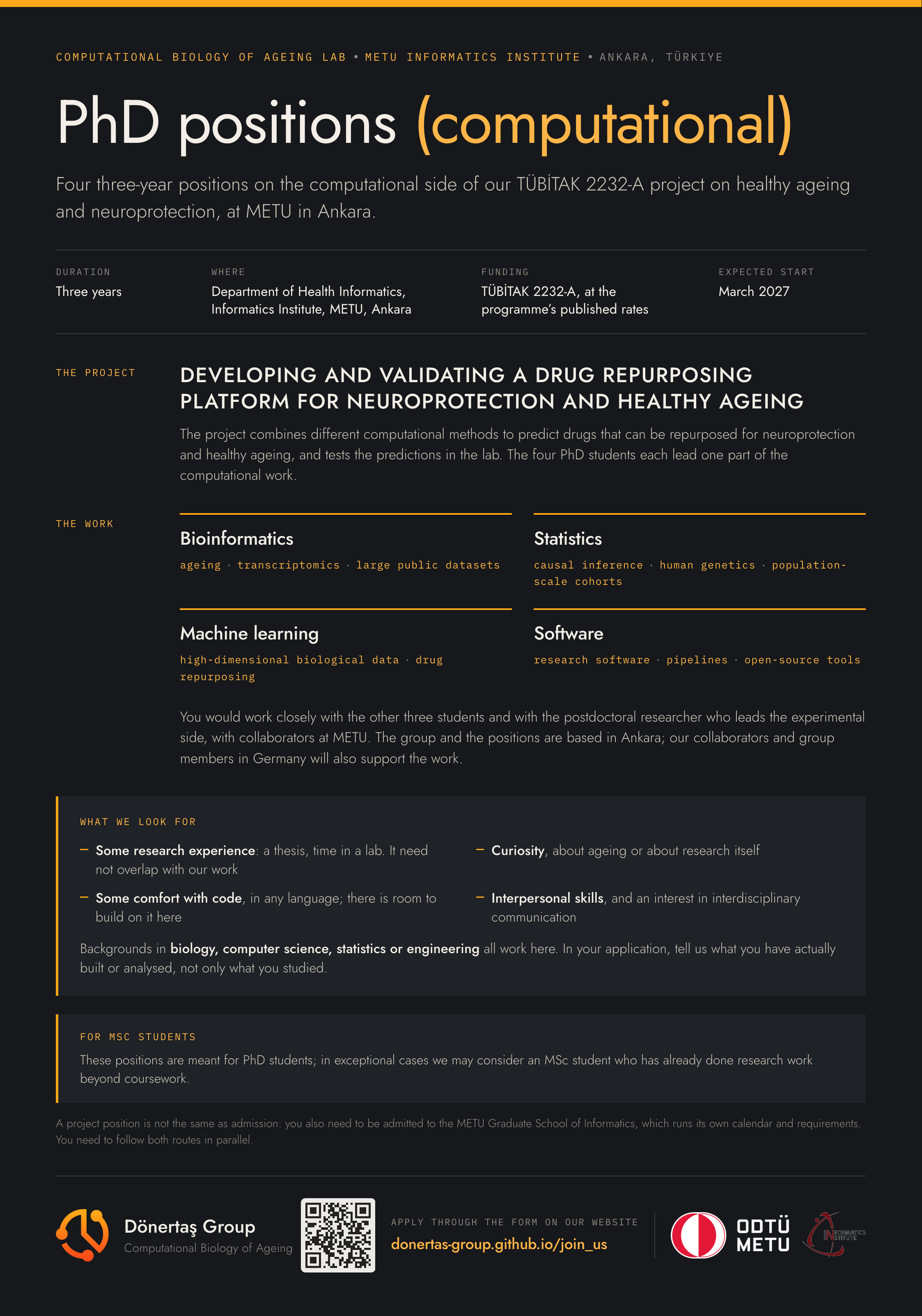
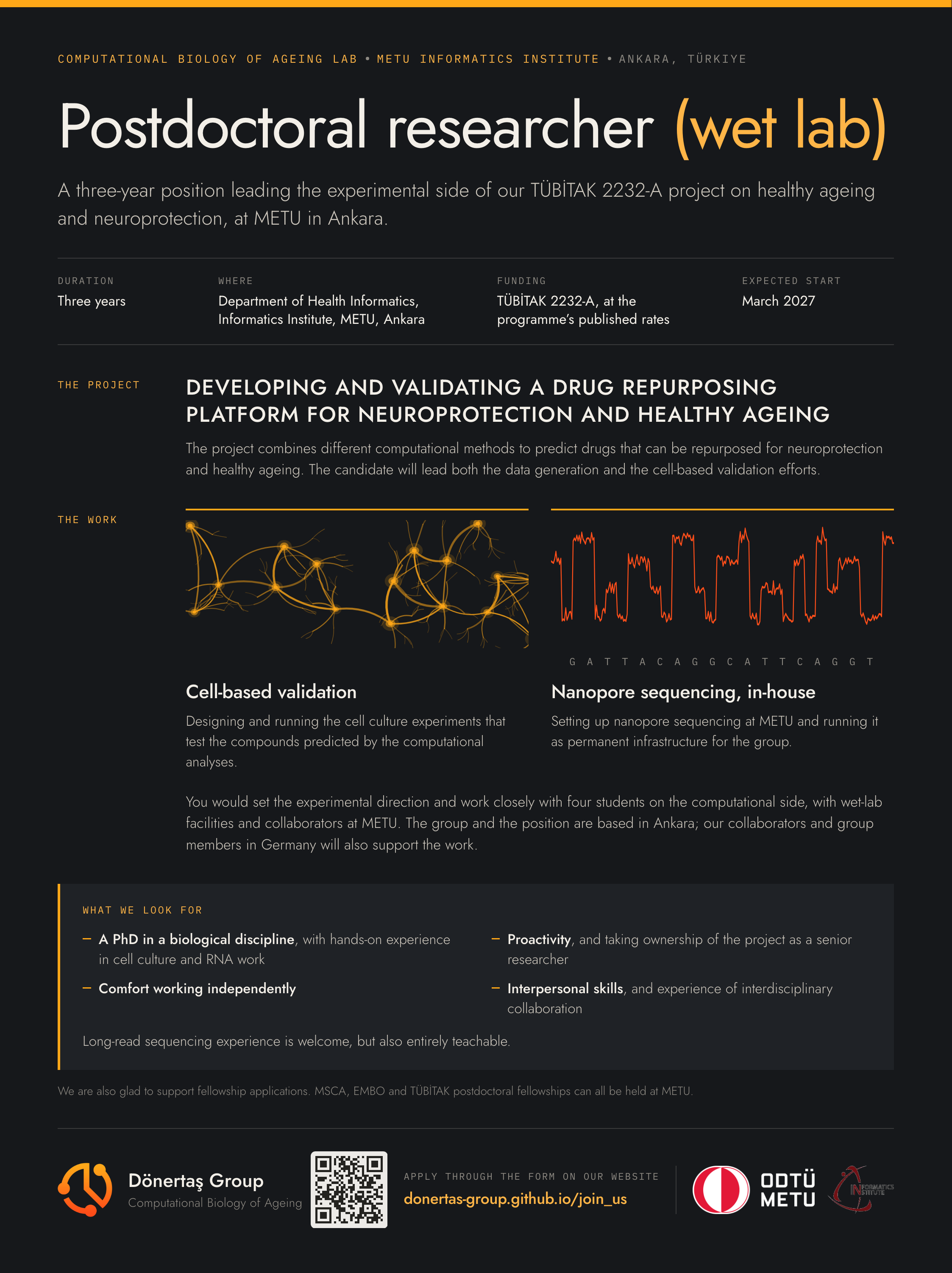
The project. Developing and validating a drug repurposing platform for neuroprotection and healthy ageing. The project combines different computational methods to predict drugs that can be repurposed for neuroprotection and healthy ageing, and tests the predictions in the lab. The four PhD students each lead one part of the computational work; the postdoctoral researcher leads the data generation and the cell-based validation.
PhD positions (computational)
| Position | Background | Keywords |
|---|---|---|
| PhD | Bioinformatics | ageing · transcriptomics · large public datasets |
| PhD | Statistics | causal inference · human genetics · population-scale cohorts |
| PhD | Machine learning | high-dimensional biological data · drug repurposing |
| PhD | Software | research software · pipelines · open-source tools |
You would work closely with the other three students and with the postdoctoral researcher who leads the experimental side, with collaborators at METU. The group and the positions are based in Ankara; our collaborators and group members in Germany will also support the work.
What we look for
- Some research experience: a thesis, time in a lab. It need not overlap with our work
- Curiosity, about ageing or about research itself
- Some comfort with code, in any language; there is room to build on it here
- Interpersonal skills, and an interest in interdisciplinary communication
Backgrounds in biology, computer science, statistics or engineering all work here. In your application, tell us what you have actually built or analysed, not only what you studied.
For MSc students. These positions are meant for PhD students; in exceptional cases we may consider an MSc student who has already done research work beyond coursework.
A project position is not the same as admission: you also need to be admitted to the METU Graduate School of Informatics, which runs its own calendar and requirements. You need to follow both routes in parallel; see the PhD students section below.
Postdoctoral researcher (wet lab)
A three-year position leading the experimental side of the project: designing and running the cell culture experiments that test the compounds predicted by the computational analyses, and setting up nanopore sequencing at METU and running it as permanent infrastructure for the group. You would set the experimental direction and work closely with four students on the computational side, with wet-lab facilities and collaborators at METU. The group and the position are based in Ankara; our collaborators and group members in Germany will also support the work.
What we look for
- A PhD in a biological discipline, with hands-on experience in cell culture and RNA work
- Proactivity, and taking ownership of the project as a senior researcher
- Comfort working independently
- Interpersonal skills, and experience of interdisciplinary collaboration
Long-read sequencing experience is welcome, but also entirely teachable. We are also glad to support fellowship applications; MSCA, EMBO and TÜBİTAK postdoctoral fellowships can all be held at METU.
How to apply
Open the application form and say in it which position you are applying for.
Other routes to join
The routes below are always open and allow speculative applications. If one of them fits you, we are glad to work on the application together.
Postdoctoral researchers
What we look for. A completed PhD, or one close to completion, and your own view of what you want to work on. We are particularly interested in postdoctoral researchers who have established experience and knowledge in wetlab but are interested in collaborating with a computational lab to develop hybrid projects. Candidates from non-biological disciplines such as mathematics, computer science or statistics are equally welcome.
Funding routes. Most postdocs join on a fellowship they hold themselves. These can all be held at METU:
- MSCA Postdoctoral Fellowships
- EMBO Postdoctoral Fellowships
- TÜBİTAK 2236-A CoCirculation3
- TÜBİTAK 2218 National Postdoctoral Research Fellowship Programme
If you are going for one of these, fill in the form early — the applications are written together, and the good ones take time.
PhD students
PhD admission runs on two tracks, and you need both.
The formal track. You apply to the METU Graduate School of Informatics. The Graduate School requires an ALES or GRE score, proof of English proficiency, notarised transcripts for both your undergraduate and graduate degrees, two reference letters, and a letter of intention. Deadlines are fixed and published under important dates — check them early, because they drive everything else.
The above is a summary for orientation only. The Graduate School of Informatics pages are the authoritative source on requirements, scores and deadlines: where anything here differs from what they say, follow them.
The group track. Admission to the Graduate School does not by itself mean joining our group. We run our own process to work out whether the fit is right, so fill in the form below while you prepare your application rather than after.
The two run in parallel, so start both in good time.
What we look for. Prior research experience — a thesis, an internship, or a project you drove rather than assisted on — and enough programming that you can make progress. You do not need to arrive with a fully-formed project, but you should be able to say what draws you to our group and roughly what you would want to understand.
Funding routes.
MSc students
MSc admission runs on the same two tracks as PhD admission, and you need both.
The formal track. Admission is the Graduate School’s to grant, not ours, so you apply to the METU Graduate School of Informatics. You will need an ALES or GRE score, English proficiency, transcripts, two reference letters, and a letter of intention, by the published deadlines.
As above, this is a summary for orientation only — the Graduate School of Informatics pages are authoritative, and where anything here differs, follow them.
The group track. Again, being admitted is not the same as having a place in the group. Fill in the form below in parallel with your application so we can discuss which projects would suit you.
What we look for. A background in biology, computer science, statistics, engineering or a related field, and some programming experience — or clear evidence that you are willing to build it quickly. We also expect some hands-on research behind you: an internship, a final-year project, or something else you carried out under supervision.
Funding routes.
BSc students and summer interns
What we look for. Curiosity, and enough programming to be dangerous — vibe coding doesn’t count! You do not need prior research experience. Be concrete about what you want to learn and roughly when you are available, since these are short stays and we can only host a few at a time.
Funding routes. Internships are normally self-funded or supported by your home institution.
This depends on arrangements we would need to check first, so tell us in the form if you are planning around it.
Calls, deadlines and eligibility rules change every year. Always check the programme’s own page before relying on anything above, and tell us what you are applying for so we can help you get the timing right.
Apply
Whatever stage you are at, the form below is how to reach us — please use it instead of email, including if you have already written to us. Not every question applies to every career stage.
Takes about ten minutes. Opens in Google Forms — no account needed.